
In this blog, Caroline Day, Deputy Named Nurse for Safeguarding at MSI Reproductive Choices UK, explains why people may access abortion care over 19 weeks – and why it is so important that we protect this access for those who need it.
In England and Wales, abortion is available up to 23 weeks and 6 days of pregnancy (and later in exceptional circumstances, such as to save the pregnant person’s life). Whilst data shows us that the majority of abortion procedures (89%) take place before 9 weeks’ gestation, access to abortion after 19 weeks is essential for many.
The most up to date abortion statistics for England and Wales (2023) show that 1-2% of abortion procedures were carried out at the ‘highest gestation grouping’ (20 weeks and over). Abortion at this stage of pregnancy is safe, effective, and for some women, life-saving.
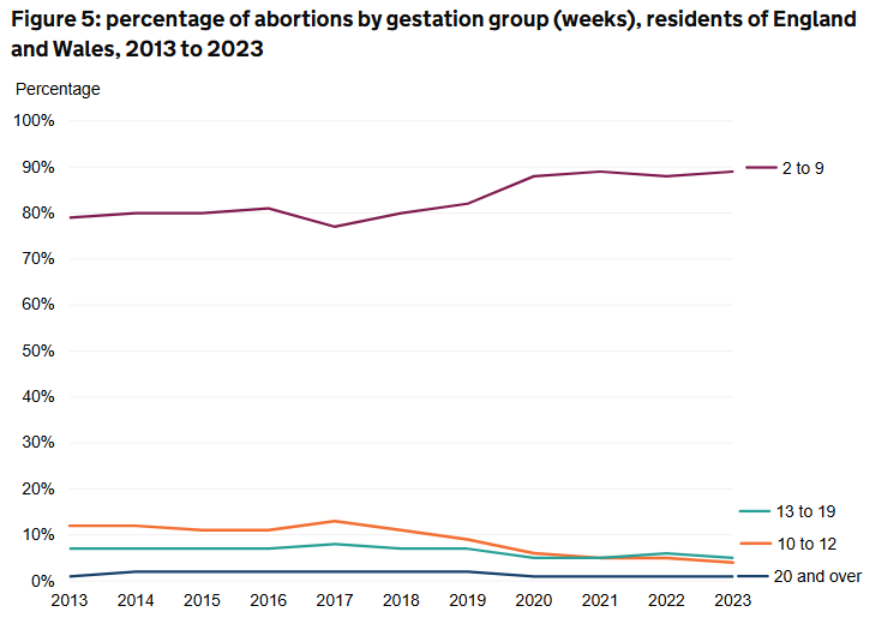
This data also shows that most abortions take place at the ‘lowest gestation grouping’ before 9 weeks gestation. In 2023, this was at 89% of all abortions.
Why people have abortions over 19 weeks
“Whatever reasons our clients have, we are here to support them.”
At MSI Reproductive Choices UK, we know that the reasons that our clients have an abortion are always personal, varied, and form part of their choice which we fully support.
However, if a client is accessing abortion care after 19 weeks, they may be experiencing complex circumstances.
For example, they may have had a foetal anomaly diagnosed at a later stage of pregnancy or have had a change in circumstances – for example, homelessness or health risks.
They might be vulnerable and not have identified a pregnancy until later on.
They might be experiencing honour-based abuse or domestic abuse – which can start or worsen during pregnancy, with some women forced to continue a pregnancy.
Some people who have experienced trauma may find it difficult to build and maintain trusting relationships with healthcare providers. As a result, they might seem disengaged at times and may need to reconnect with providers multiple times throughout their treatment. We will always do our best to support clients in a way that works best for them, whenever they get in touch.
Whatever reasons our clients have, we are here to support them with non-judgmental, safe and supportive advice and care – throughout their journey with us and beyond.
Accessing abortion over 19 weeks: one client’s story
One client disclosed she had recently separated from an abusive partner, who had prevented her from accessing care until she reached 23 weeks’ gestation. She was desperate to access care but being actively obstructed by her partner from 11 weeks onwards. This meant that she could not do so until she reached 23 weeks’ gestation. The appropriate support was arranged, and she was able to access the necessary ongoing support as well as the reproductive healthcare she needed.
This story powerfully illustrates how domestic abuse can severely impact a woman’s ability to access safe abortion care. This client was being coerced into not attending her treatment appointment, and it took 12 weeks from initial contact with MSI UK for her to reach a point where she could safely attend. Had the legal gestational limit been lower, this client would have been put in the position of continuing an unwanted pregnancy while in an abusive relationship, or risking criminal prosecution, even jail.
The trusting relationship we built with this client to understand her needs was key. We were able to safeguard and support her at every step of her journey with us until she was able to access the care that she needed and provide her with ongoing support.
Safeguarding processes for any clients accessing abortion care after 19 weeks
“Presenting for an abortion after 19 weeks is not in itself a safeguarding concern.”
We have a robust safeguarding process for all our clients regardless of their gestation. Safeguarding in abortion care involves proactive measures to identify, manage, and protect vulnerable clients from harm. It is important to highlight that having an abortion after 19 weeks is not in itself a safeguarding concern.
At the point of booking (online or by calling us), we will screen for any safeguarding needs. The team will ensure the clients’ immediate safety and make onward referrals if indicated or requested.
“We safeguard all of our clients to a high standard and work with them to ensure they have the most appropriate ongoing support.”
We safeguard all clients to a high standard and work with them to ensure they have the most appropriate ongoing support with any concerns they may have or that we identify. Our safeguarding structure at MSI UK ensures robust safeguarding oversight and support at every stage of their journey.
The dangers of reducing the legal abortion limit
Reducing the legal limit for abortion and restricting access would further disproportionately harm the most vulnerable individuals. They may already be navigating difficult and emotionally distressing situations, and by forcing them into continuing pregnancies they do not chose, or towards unsafe alternatives, they would be exposed to serious health risks and/or legal consequences.
It is well documented that reducing access to services at any stage of pregnancy does not reduce the amount of people needing to access the service. In fact, this results in an increase in the number of people seeking unsafe abortions.
Evidence from the British Medical Journal (BMJ) and the Royal College of Obstetricians and Gynaecologists (RCOG) shows there is no case for reducing the time limit – and that doing so would be harmful for medical care and for gender equality.
Our focus is always on supporting and empowering our clients to have choice and access to safe, evidence-based reproductive healthcare should they choose it.
Gestation calculator
Find your estimated gestation and which abortion treatments might be available to you.
Read more
Surgical abortion
Surgical abortion is a safe and simple procedure used to end a pregnancy.
Read more
Advocacy and Opinions
Raising our voice to remove barriers to accessing safe abortion and contraception services in the UK.
Read more