


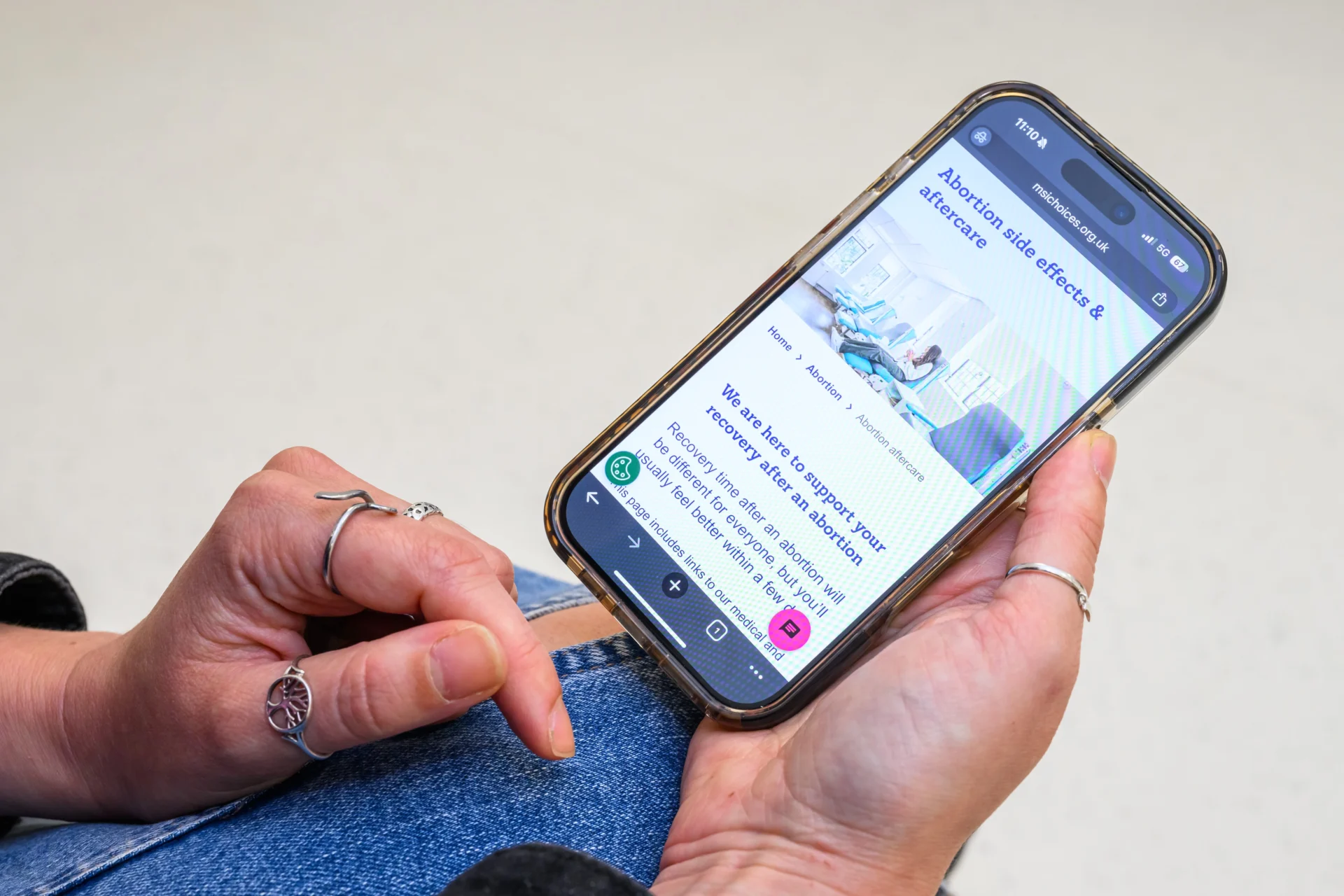
Your guide to abortion care: video hub


Your guide to abortion care: video hub
On this page, you will find a series of videos answering common questions about abortion care.
We know how important it is to find clear, accurate and accessible information about abortion. In this video series, our nurses and midwives share answers to your questions – including how to access abortion care in England, what to expect during your treatment, and the support available during and after an abortion.
You can find full transcripts for each video at the bottom of this page.
Before your abortion treatment
How to access abortion care in England
Learn all you need to know about accessing NHS-funded abortion care in England.
Support available during and after an abortion
Learn what support is available to you during and after an abortion.
Abortion myths and facts (fertility, safety and more)
Learn as we debunk some common myths about abortion care.
The difference between medical abortion and surgical abortion
Learn more about the difference between a medical abortion (abortion pills) and a surgical abortion.
What is a medical abortion? All you need to know
Learn key facts about medical abortion (abortion pills) and what we offer at MSI UK.
What is a surgical abortion? All you need to know
Learn key facts about surgical abortion, and what this treatment involves at MSI UK.
During your abortion treatment
Bleeding during a medical abortion
Learn what bleeding to expect during a medical abortion, and when to get in touch.
How to manage pain during a medical abortion
Learn what pain to expect during a medical abortion, and how to manage pain.
After your abortion treatment
What to expect: bleeding after a medical abortion
Learn what bleeding to expect after a medical abortion.
What to expect: bleeding after a surgical abortion
Learn what bleeding to expect after a surgical abortion.
What to expect: pain after a surgical abortion
Learn what kind of pain to expect after a surgical abortion.
When will I get my period after an abortion?
Learn all you need to know about your first period after an abortion, including when it will return.
What to do if you get a positive pregnancy test after an abortion
Learn why you might get a positive pregnancy test after an abortion, and when you should get in touch.
Fertility after an abortion: myths and facts
Learn as we debunk a common myth about abortion and your future fertility.
Looking for more videos?
To stay up to date with our video content, you can subscribe to our YouTube channel.
Transcripts
Find transcripts of our abortion care video series by clicking below.
Abortion is funded by the NHS in England. It is available up to 23 weeks and 6 days of pregnancy, through NHS providers like MSI Reproductive Choices UK.
If you’ve had a positive pregnancy test and are considering abortion, you are not alone. We’re here to support you through your decision, and talk to you about all of the options you have available.
If you decide that abortion is the right option for you, you can self-refer to an NHS provider like MSI UK. You do not need a GP referral to access NHS-funded abortion care – just get in touch by calling our booking line, using our webchat, or booking online on our website.
When you get in touch, we will discuss your treatment options with you. These options will depend on factors like your gestation and your past medical history. We will discuss all of this with you.
If your gestation is under 9 weeks and 6 days, we offer medical abortion treatment (also known as ‘abortion pills’). At MSI UK, we offer both face-to-face medical abortion care and at-home medical abortion care (also known as ‘telemedicine’).
In our clinics, we also offer surgical abortion treatment from 6 weeks gestation and up to 23 weeks and 6 days gestation.
Following your treatment, your care does not end. We have an aftercare line available 24 hours a day, 7 days a week, where you can talk to one of our nurses or midwives about your recovery.
We also provide NHS-funded, confidential counselling services, available at any time before, during and after your treatment – even if your abortion was some years ago.
Please remember that we are here for you, and you can get in touch with us at any time.
If you’re accessing abortion care and looking for support, advice or someone to talk to – we are here for you.
We will always offer impartial, confidential and non-judgemental support, and provide a safe space where you can ask any questions you have.
You can get in touch with us whenever you want, even if you haven’t made a decision about whether to have an abortion. If you’re not ready or unable to call us, we have a live chat available on our website, where you can talk to us anonymously, if you prefer.
It can sometimes help to hear from people who have accessed abortion care themselves. On our website, you can read abortion stories that our clients share with us, to help you know what to expect and reassure you that you are not alone.
At MSI UK, we also offer NHS-funded counselling services, available at any time before, during or after your treatment – even if your abortion was some years ago.
If you’ve had treatment and have questions about your recovery, we have an aftercare line available 24 hours a day, 7 days a week. You can call us anytime, as many times as you want, to talk to our friendly team of nurses and midwives.
We are here for you.
Abortion is common. Nearly 1 in 3 pregnancies end in an abortion worldwide. However, abortion stigma means that this aspect of healthcare is not often talked about in everyday conversation, leading to a lack of access to relevant and accurate information.
We’re here to debunk some common myths about abortion, and provide you with the facts so that you can make an informed choice about your healthcare, your body, and your future.
Will abortion affect my fertility?
Some people worry that having an abortion will impact their ability to get pregnant again. This is not true: there is no link between abortion and infertility, and that’s true whether you have one abortion or more than one.
In fact, you can conceive again quickly after an abortion. An egg can be released from the ovary almost immediately after your treatment, so you could become pregnant again before your next period.
Is abortion actually safe?
Abortion is a very safe and common medical procedure. Like any surgical procedure or medical treatment, there are some risks, and we will explain these to you clearly during your consultation with us.
Some people also worry that having more than one abortion is not safe, but this is also not true. It is safe to have more than one abortion.
Can abortion affect my long-term health, or increase the risk of breast cancer?
Having an abortion will not impact your long-term health. There is no link between abortion and breast cancer, and no increased risk to your health from having an abortion.
Can I have more than one abortion on the NHS?
Yes: there is no limit to the number of abortions you can have via the NHS.
How will I feel after an abortion?
We know that people may experience a range of emotions after using abortion services. For some, the decision to have an abortion might be a tough one, but for others, it might not.
The most common feeling to experience after an abortion is relief, but there is no right or wrong way to feel after an abortion. However you feel, you are not alone.
Abortion providers will always offer confidential, impartial, and non-judgemental support should you wish to discuss your decision. At MSI UK, we provide free counselling services as part of abortion care.
There are two types of abortion: a medical abortion (also known as abortion with pills) and a surgical abortion.
Most people having an abortion can choose how it will be carried out. Your choice will depend on your individual circumstances, your gestation (how many weeks pregnant you are), your medical history and how you feel about the different options.
Medical abortion:
A medical abortion uses two types of medication – mifepristone and misoprostol – to end the pregnancy. It is a safe and effective treatment option, and is available at MSI UK up to 9 weeks and 6 days gestation.
We offer both face-to-face medical abortion care and at-home medical abortion care (also known as ‘telemedicine’). Whether you are accessing our at-home abortion pills service or you are visiting one of our clinics for a medical abortion, you will take the pills and pass the pregnancy at home.
During a medical abortion, most people will have significant cramping pain and experience heavy vaginal bleeding. If pain is severe, this is usually short-lived and is relieved when the pregnancy passes.
To determine whether the treatment has been successful, you will need to take the pregnancy test we provide, 3 weeks after your treatment.
Surgical abortion:
A surgical abortion is a safe, simple and effective procedure. The pregnancy is removed vaginally by an experienced doctor. We offer surgical abortion care up to 23 weeks and 6 days gestation, as a day treatment in our clinics.
The procedure can differ depending on your gestation, so the amount of time you will spend at the clinic might differ too.
The procedure can sometimes take place under local anaesthetic or a light anaesthetic. If you have a local anaesthetic, the procedure might feel uncomfortable. You might also have some pain or cramping for a few days, up to a week, after the abortion, and some bleeding is normal.
You are not alone in making your decision. We will talk it through with you, and help you make a choice that’s right for you.
A medical abortion uses two types of medication – mifepristone and misoprostol – to end the pregnancy. It is a safe and effective treatment option, and is available at MSI UK up to 9 weeks and 6 days gestation.
We offer both face-to-face medical abortion care and at-home medical abortion care (also known as ‘telemedicine’).
If you meet the safety criteria to allow for medical abortion without a scan, you can access our telemedicine service. The abortion medication can either be collected by you from one of our clinics or posted to your home address.
If you are attending one of our clinics for an appointment – for example, because you need to have a scan to determine your gestation – you will pick up your abortion pills at the end of your appointment.
During a medical abortion, most people will have significant cramping pain and experience heavy vaginal bleeding. If pain is severe, this is usually short-lived and is relieved when the pregnancy passes.
To determine whether the treatment has been successful, you will need to take the pregnancy test we provide, 3 weeks after your treatment.
A surgical abortion is a safe, simple and effective procedure. The pregnancy is removed vaginally by an experienced doctor. We offer surgical abortion care up to 23 weeks and 6 days gestation, as a day treatment in our clinics.
The procedure can differ depending on your gestation, so the amount of time you will spend at the clinic might differ too.
The procedure can take place under local anaesthetic or a light anaesthetic. If you have a local anaesthetic, the procedure might feel uncomfortable. You might also have some pain or cramping for a few days, up to a week, after the abortion, and some bleeding is normal.
A medical abortion involves taking two types of medication: mifepristone and misoprostol.
Most people can continue their daily routine as normal after taking the first medication, mifepristone, but occasionally you may experience some bleeding and pain.
After taking the second medication, misoprostol, you are likely to experience strong cramping and bleeding which can last a few hours, but pain and bleeding is different for each person.
Bleeding during the abortion
Bleeding can be light, moderate, or heavy during a medical abortion, and it’s different for everyone.
Bleeding will usually start within the first few hours of taking the second medication, but can take up to 48 hours. It might start as light bleeding and then get heavier, or it might start as a heavy bleed.
During the abortion, it would be expected for you to pass the pregnancy tissue, and most people will pass blood clots, which can be as large as a lemon. Not all clots are circular or a definite red in colour.
If the clots are larger than the size of a lemon, please call our 24-hour aftercare line.
When should I ask for help?
If you experience bleeding that is soaking through more than two maternity pads in 1 hour, please call our 24-hour aftercare line. We will discuss your bleeding and may advise you to seek urgent medical advice, for example, visiting A&E.
If you experience very heavy bleeding and feel very unwell, you should call 999.
If you have less bleeding than your normal period or no bleeding by 48 hours after you’ve taken the second pills, misoprostol, it is possible that the medical abortion has not worked, so please call our 24-hour aftercare line.
We are here for you.
A medical abortion, also known as abortion pills, uses two types of medication, mifepristone and misoprostol, to end a pregnancy.
Everyone is different, but most people will experience significant cramping pain. This can come and go in waves, which is why we advise taking pain relief regularly to ensure you have a good base.
Preparation is key. We recommend having all of the pain relief medication recommended in our booklet available to avoid long periods without pain relief.
Some people start to experience pain immediately and some later on. While most people can continue their daily routine as normal after taking the first medication (which is mifepristone), you may occasionally experience some pain.
After taking the second medication (misoprostol), most people will start experiencing significant cramping pain. This pain usually correlates with passing clots, and often eases once you have passed the pregnancy.
Pain relief should be taken before you take the second medication (misoprostol) or if preferred, when you start to feel cramps building up.
We have detailed guidance on pain relief, including the type you can use and how often, in our Medical Abortion Treatment and Aftercare booklet.
If your pain has still not reduced after following our advice, please call our dedicated aftercare line, where you can talk to one of our nurses.
We are here to support you.
Once the pregnancy has been passed, both the pain and bleeding will usually reduce.
The bleeding may be quite heavy for a day or two as your uterus (womb) returns to its normal size.
This is what we mean by heavy bleeding (see page 27 of our medical abortion booklet).
It is usual to pass clots for a few days and intermittently for 1 to 2 weeks.
It’s normal to have some bleeding or spotting, possibly with some small clots, for 2 to 4 weeks after a medical abortion, and for some people, light bleeding and spotting can happen for up to 8 weeks after.
The bleeding may come and go and be quite irregular, and you may continue to pass some smaller clots.
You can use any menstrual products during and after the abortion, but using period pads is easier to track and monitor your bleeding. On days your bleeding is heavy, we recommend wearing a suitable pad such as the thick maternity ones.
If you use tampons or menstrual cups, please consider using period pads instead for 48 hours after taking the second tablets (misoprostol), as this will help you monitor your bleeding.
If you decide to use tampons or menstrual cups, please ensure that you change them regularly.
If you ever feel worried, remember our 24-hour aftercare line is always available for you.
We are here for you.
It is normal to have some bleeding after your surgical abortion.
This may be heavier than your normal period, with small clots, and can last for up to 2 weeks.
If it lasts for longer, or you experience very heavy bleeding that soaks through more than two sanitary pads in an hour, please call us right away on our 24-hour aftercare line.
We are here for you.
Cramping pain is normal after a surgical abortion. It can be constant or come and go, which may last up to two weeks.
Cramping pain can be managed with some simple pain relief medications.
You may also feel some soreness in the vein where the anaesthetic was injected, but this usually settles within a few hours.
Heat can help with cramps and make you feel more comfortable. Try applying a heat pad or a warm hot water bottle wrapped in a towel or blanket to your lower abdomen.
Wearing comfy loose clothing and relaxing at home can also reduce pain.
If you are in discomfort, you may also want to take some pain relief tablets such as paracetamol, ibuprofen, or codeine, but remember to avoid taking ibuprofen until 12 hours after your procedure, if you had the painkiller suppository.
We do not recommend using aspirin as pain relief, but if you are taking it for medical reasons, you should continue to do so.
If your pain has still not been reduced after over-the-counter pain relief, worsens, or persists, please call our 24-hour aftercare line.
We are here for you.
Your first period will usually return between 4 to 8 weeks following a successful abortion.
It is also normal to pass more clots than usual.
Some hormonal contraception can stop or change your periods. Therefore, if you started contraception around the time of your abortion, this may explain why your period has not returned.
We are here for you.
There are a few reasons you might get a positive result on your pregnancy test after your abortion.
One reason is that you’ve taken the pregnancy test we provided too early, without waiting the recommended 3 weeks after your abortion.
You might also get a positive result because you’ve used a shop-bought test instead of the specially calibrated test we provided as part of your treatment.
Shop-bought tests can remain positive for up to two months even though you are no longer pregnant. This is because pregnancy hormones can remain in your system for up to two months after an abortion.
If you’ve taken the pregnancy test we provided incorrectly and would like another pregnancy test to be sent to you, we can arrange this.
When should you get in touch?
Please call our dedicated 24-hour aftercare line if you have taken our pregnancy test 3 weeks after treatment and see a strong positive result.
If you have a faint positive result and would like to discuss this with a nurse, feel free to get in touch.
Please also call us if you continue to have symptoms such as heavy bleeding, gushes with clots, or abdominal pain, 3 weeks after treatment.
Another reason you should get in touch is if you’re not confident that you’ve passed the pregnancy. For example, you haven’t had any or much heavy bleeding or pain.
What will the next steps be?
Often, our aftercare team will talk through your treatment, symptoms, and aftercare, arrange for another test to be sent to you, and advise you retest in 2 weeks time.
Occasionally, we may offer you a follow-up appointment at one of our clinics.
Remember, we have a 24-hour dedicated aftercare line where you can talk to one of our nurses about your aftercare and recovery.
We are here to support you. Your choice, our support.
Some people worry that having an abortion will impact their ability to get pregnant again. This is not true. There is no link between abortion and infertility, and that’s true whether you have one abortion or more than one.
In fact, you can conceive again quickly after an abortion. An egg can be released from the ovary almost immediately after your treatment, so you could become pregnant again before your next period.
Contraception is offered as part of NHS-funded abortion care.
Your choice, our support.
Learn more about abortion
Visit the pages below to learn more about abortion, how to access NHS-funded care with MSI UK and read abortion stories from our clients.

Abortion
Learn all you need to know about abortion care and your options.
NHS-funded abortion care
Learn more about how to access NHS-funded (free) abortion care with MSI UK.
Abortion stories
Read abortion stories submitted by our clients, to know what to expect.